
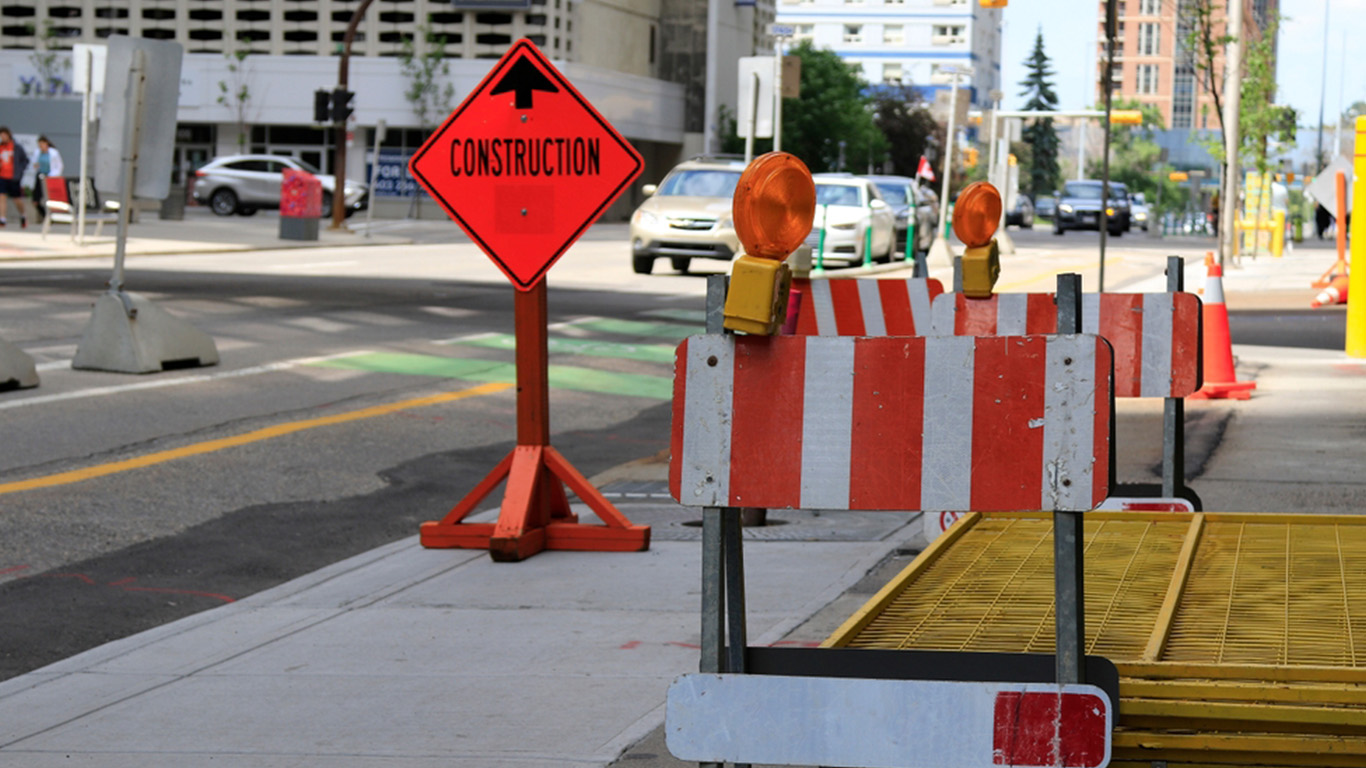
It’s June, which means construction season is kicking into high gear. Whether it’s topping off a commercial building, installing new sewer pipes below grade, or anything in between, one thing’s for sure: many of those jobs will have a higher price tag.
Let’s have a look at some of our key data and construct an idea of how much more the work might be costing governments and the private sector for those larger-scale projects, as well as what construction sector businesses are saying.
One in three construction businesses expects an increase in sales, and to charge more
Every quarter, the Canadian Survey on Business Conditions asks businesses across all sectors a number of questions related to expectations, obstacles, and other topics.
In the second quarter of 2026, almost one in three (32.7%) businesses in the construction sector expected to raise prices for their services in the next three months, while just over three in five (61.4%) expected no change, and a very small proportion (5.9%) expected to lower prices.
Just over one in four (26.8%) construction businesses also expected increased sales in the next three months, more than half (56.5%) expected no change, while 16.8% expected a decrease in sales.
Expenses expected to outrun income; cost-related obstacles cited by most businesses
Often the main factor behind some construction businesses deciding to raise prices is the ever-increasing costs of doing business. In the second quarter of 2026, the proportion expecting increased operating expenses (46.5%) in the next three months was almost double that which expected an increase in operating income (24.1%).
Similarly, construction businesses were more than twice as likely to expect a decrease (32.1%) than an increase (13.3%) in profitability in the next three months.
Inflation was the most expected obstacle over the next three months, reported by more than half (53.0%) of construction businesses, followed by transportation costs (39.4%), cost of inputs (32.7%), and fluctuations in consumer demand (30.6%).
Among construction businesses citing the cost of inputs as an obstacle, more than three in five (61.8%) said the cost of raw materials would be an obstacle over the next three months, while smaller proportions cited the costs of labour (58.3%), energy (48.1%), and capital (18.9%).
Fuel prices up sharply, other materials also increase in price
Statistics Canada tracks the price change of various inputs manufactured in Canada through its producer price indexes. Although Canadian construction companies may use a mix of domestic and imported materials and equipment, price changes on the domestic side can give us an idea of price pressures.
Sustained high fuel prices may cause further upward pressure on producer prices, and also what construction companies charge for their services. The conflict in the Middle East that began at the end of February pushed up prices for crude oil, and in turn, energy products.
In April 2026, diesel prices were significantly higher in Ontario (+66.3%), the Prairie region (+63.6), the Atlantic Region (+63.1%), British Columbia (+54.5%) and Quebec (+46.1%) than in April 2025.
Prices for logging, construction, mining, and oil and gas field machinery and equipment (including cranes, concrete mixers, and paving equipment) (+5.2%) and metal building and construction materials (+2.2%) rose in April from a year earlier, as did cement, glass, and other non-metallic mineral products (such as gypsum) (+0.8%).
Prices for asphalt (except natural) and asphalt products also saw a modest increase (+1.9%), and decreased slightly for medium and heavy-duty trucks (-1.0%).
Contractors charging more
The Building Construction Price Index measures the change in prices charged by contractors.
In the first quarter of 2026, contractors charged 3.6% more than in the same quarter a year earlier for non-residential building construction (average for all types of jobs) in 15 of the most populous census metropolitan areas (CMAs). London, Ontario (+8.7%), Québec, Quebec (+6.9%), and Saskatoon, Saskatchewan (+5.0%) rose the most.
The average change in price for the 15 CMAs also varied by the type of job. Structural steel framing (+10.3%) rose the most, followed by metal fabrications (+8.6%). Conversely, prices were little changed for electrical (+0.6%) while fire suppression work was cheaper (-6.2%).
All types of jobs also saw fluctuations in price depending on the building type and the materials used—for example, steel components were affected by retaliatory tariffs through much of 2025.
Construction expenditures set to rise in 2026
Capital expenditures on construction of non-residential assets are forecast to reach $133.8 billion (private) and $140.2 billion (public) in 2026, both up from 2025.
The most recent data on repair expenditures are from 2024, when $26.4 billion was spent on private assets, down from $28.6 billion in 2023. Conversely, the $21.2 billion spent on public assets was up from $20.1 billion a year earlier.
To learn more
Check out our Construction statistics and Producer Price Indexes portals for the latest data and analysis.

Contact information
For more information, contact the Statistical Information Service (toll-free 1-800-263-1136; 514-283-8300; infostats@statcan.gc.ca) or Media Relations (statcan.mediahotline-ligneinfomedias.statcan@statcan.gc.ca).